UK property investment software comparison

Sentinel vs PropertyData, Property Filter, Rightmove & Zoopla

Your AI judgement engine. Built to unlock the deal inside any property.

There has never been more technology available to property investors. Portals, market intelligence and sourcing platforms each bring valuable capabilities to the investment process.

Sentinel takes a different starting point.

Rather than simply appraising a property against its asking price or market value, Sentinel starts with you.

Your capital. Your objectives. Your required returns. Your experience.

It then evaluates the asset, the vendor and the possible investment strategies together to engineer a deal that works for your circumstances.

It's the difference between analysing a property and engineering a transaction.

Understanding the market

Different platforms. Different strengths.

Property technology has evolved considerably.

Investors can now access listings, market intelligence, sourcing tools, financial modelling and AI-powered property analysis.

Many platforms offer overlapping capabilities, but their core propositions remain different.

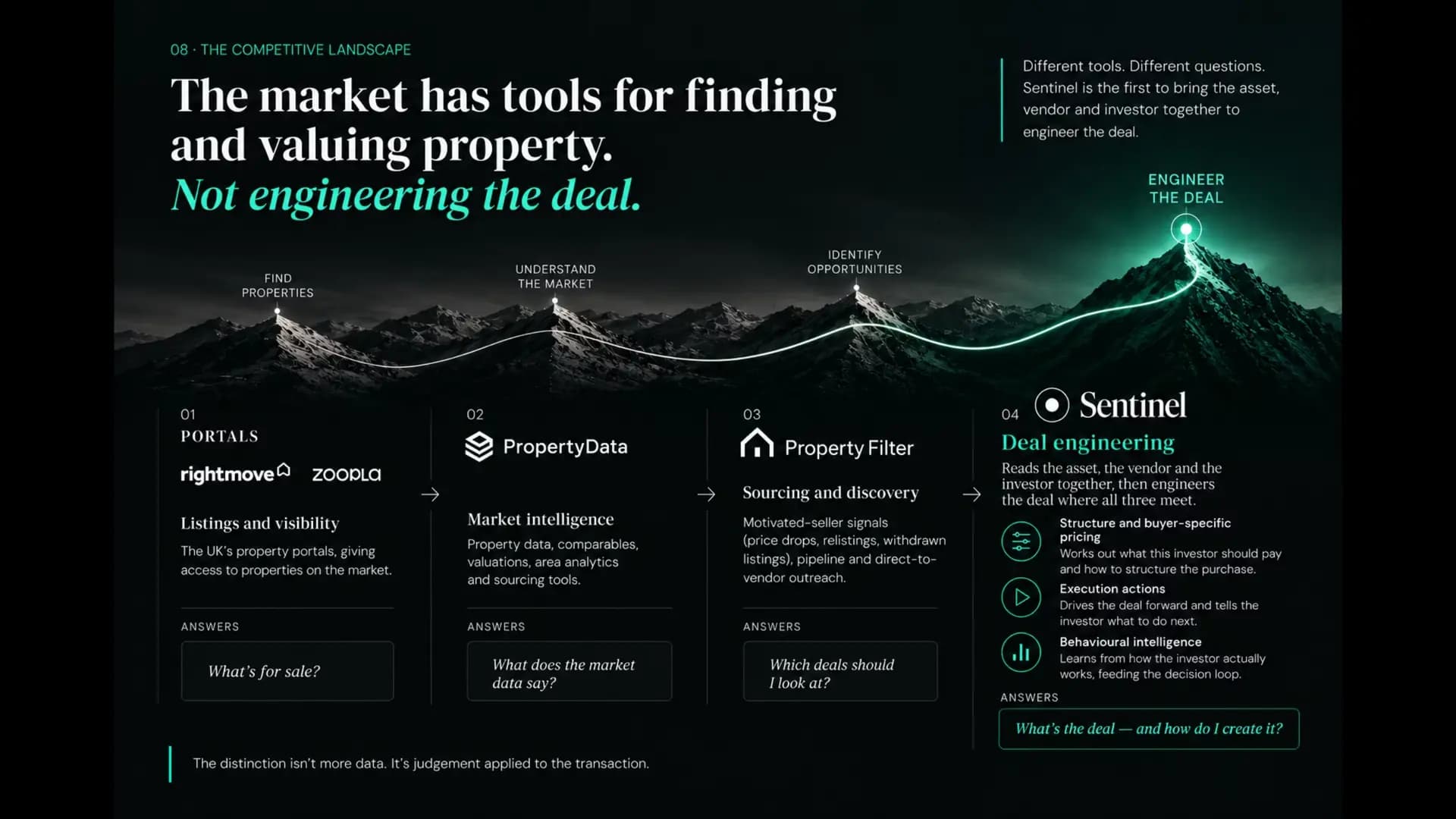
The evolution of UK property technology, from property discovery and market intelligence to opportunity identification and Sentinel's investor-first Deal Engineering.

Scroll sideways to see all four stages →

The distinction isn't simply access to more information. It's what happens to that information when an investment decision needs to be made.

Side-by-side comparison

How does Sentinel compare with other property investment software?

If you're weighing up a PropertyData or Property Filter alternative, the most useful difference isn't the feature list. It's the starting point.

The comparison below focuses on each platform's primary proposition. It doesn't suggest any platform offers only one capability.

PlatformPrimary focusCore investor question
RightmovePrimary focusProperty listings and discoveryCore investor questionWhat's available?
ZooplaPrimary focusProperty listings, prices and market informationCore investor questionWhat's available, and what does the market suggest?
PropertyDataPrimary focusProperty research, sourcing and investment analysisCore investor questionWhat does the market evidence tell me?
Property FilterPrimary focusProperty sourcing, opportunity and vendor intelligenceCore investor questionWhere might the next opportunity be?
SentinelPrimary focusInvestor-first AI judgement and Deal EngineeringCore investor questionWhat would make this property a viable deal for me?

Sentinel vs Rightmove and Zoopla

From finding a property to finding the deal within it.

Rightmove and Zoopla are valuable starting points for property investors.

They provide access to property listings, asking prices, photographs, floor plans and other information needed to identify potential acquisitions.

But finding a property is only the beginning.

Sentinel takes an opportunity and evaluates it against your objectives, capital, financial requirements and possible acquisition strategies.

Instead of simply asking whether a property looks attractive at its advertised price, Sentinel explores what price, structure or strategy could make the investment viable.

You don't need to stop using Rightmove or Zoopla.

Find the property wherever you like. Let Sentinel help you engineer the deal.

Sentinel vs PropertyData

From market intelligence to investor-specific judgement.

PropertyData provides UK property investors with extensive research, sourcing, market intelligence and investment analysis capabilities.

Comparable sales, rental evidence, market conditions and financial modelling all play an important role in evaluating property opportunities.

Sentinel uses market intelligence as part of a broader decision-making process. The difference lies in the starting point.

Rather than treating the property's current price and a selected strategy as the basis of the appraisal, Sentinel begins with your required outcome.

It evaluates what you can afford, the returns you require, the strategies you can realistically execute and the acquisition terms that might make the transaction viable.

Market value remains important. But market value isn't the same as worth.

Valuers have long distinguished between the two. Market value is what a property should achieve on the open market. Worth is its value to a particular investor, with their own capital, objectives and constraints.

Sentinel establishes that worth, and helps you act on it.

Sentinel vs Property Filter

From identifying opportunities to engineering acquisitions.

Property Filter helps investors discover potential opportunities through sourcing, filtering, market intelligence and vendor-related information.

Identifying an attractive property or a potentially motivated seller can create an opening for negotiation.

But knowing an opportunity exists doesn't tell you how to structure the transaction.

Sentinel evaluates the opportunity against your financial position, objectives and constraints. It explores alternative strategies, acquisition prices and transaction structures, using any known vendor circumstances to inform the investment thesis and negotiation approach.

The question isn't simply whether the vendor might be motivated. It's what that motivation could mean for the price, terms and structure of a deal that works for you.

Finding an opportunity is the beginning. Engineering the transaction is where the value is created.

Property appraisal vs Deal Engineering

Most appraisals test the deal. Sentinel engineers it around you.

Experienced investors have always worked backwards from required returns.

Residual valuations, maximum purchase price calculations and return-on-capital models are established investment techniques. Sentinel doesn't claim to have invented them.

What Sentinel does differently is bring investor-specific judgement and multiple deal variables together in one process.

In a conventional appraisal, your criteria are the test at the end.
In Sentinel, they're the brief at the start.

Conventional appraisal

Start with the property.

  1. 1Establish the property price and market evidence.
  2. 2Select an investment strategy.
  3. 3Calculate costs, income and returns.
  4. 4Compare the result with the investor's criteria.

Does this deal meet my targets?

Sentinel Deal Engineering

Start with the investor.

  1. 1Understand the investor's capital, objectives, experience and required returns.
  2. 2Evaluate the asset and possible investment strategies.
  3. 3Explore price, funding, structure and terms together.
  4. 4Consider vendor circumstances and practical execution constraints.
  5. 5Engineer the most viable acquisition approach for that investor.

What combination of strategy, price and terms could make this a deal?

Sentinel doesn't simply solve for the purchase price. It considers the interconnected variables that determine whether an investment can work.

  • A different strategy changes the numbers.
  • A different funding structure changes the capital requirement.
  • Different vendor terms can change the transaction.
  • And a different investor can change the entire decision.

That's investor-first Deal Engineering.

Asset. Vendor. Investor.

The same property can be two completely different deals.

Imagine two investors evaluating the same property.

The market value is the same. The rental evidence is the same. The asking price is the same.

But one investor has significant cash, refurbishment experience and a long-term capital growth strategy.

The other has £30,000 available, limited development experience and needs immediate positive cash flow.

The first might consider refurbishment, redevelopment or a longer-term value-add strategy.

The second might need a lower capital commitment, a different financing structure or a completely different investment approach.

Now introduce the vendor.

Perhaps the seller needs a rapid completion. Perhaps they have no mortgage. Perhaps they could consider staged payments or deferred consideration.

The possibilities change again.

The property hasn't changed. But the deal has.

Sentinel brings the asset, vendor and investor together.

THE ASSETTHE VENDORTHE INVESTORTHE DEAL
The Asset
What is the property, what could it become, and where are the risks and opportunities?
The Vendor
What are the seller's circumstances, objectives and potential flexibility?
The Investor
What capital, experience, objectives, risk appetite and returns does this investor require?

The deal exists where all three meet.

Sometimes the answer is a lower price.

Sometimes it's a different strategy.

Sometimes it's in the terms.

And sometimes the right decision is to walk away.

The AI judgement engine

Judgement doesn't end when the numbers work.

A profitable-looking appraisal doesn't acquire a property.

You still need to decide what to offer, how to negotiate, what risks to investigate and what to do next.

Sentinel connects the investment thesis to the actions required to progress the transaction.

It's built around understanding both the property and the person investing in it. That means considering your financial requirements, experience and capacity to execute, rather than producing the same recommendation for everybody.

Today

Sentinel provides investment appraisal, strategy analysis and negotiation guidance within one connected deal workflow.

Next

It extends that judgement into proactive guidance.

An AI judgement engine that doesn't simply wait for your next question, but helps you recognise what matters and what to do next.

Explore the full product walkthrough

The Sentinel difference

Stop asking what a property is worth. Start asking what makes it a deal.

Market intelligence tells you about the property.

Sentinel brings that intelligence together with your objectives, the vendor's circumstances and the strategies available to engineer the investment decision.

Unlock the deal inside any property.